
Earth’s Magnetic Field: Distribution in the Space Around the Earth
2023-01-05 · Latest
Introduction
The Earth’s magnetic field is the field distributed in the space around the Earth. Its magnetic south pole points approximately towards the geographic north, and its magnetic north pole approximately towards the geographic south. The field lines run horizontally near the equator and vertically to the surface near the poles. The field is weakest at the equator and strongest at the poles. The field at the Earth’s surface varies with time under the influence of many factors.
The geomagnetic field consists of three parts: the main field, the external field and magnetic anomalies.
The main field, also called the normal field, accounts for more than 99 % of the geomagnetic field. It is produced mainly by convection of currents in the core — an internal source.
The external field originates outside the Earth and is superimposed on the main field as various short-term variations. The main ones are variations in step with the sunspot cycle, the daily variation (related to the effect of solar radiation on the high-altitude ionosphere), and magnetic storms.
Magnetic anomalies are secondary fields formed around underground rock, ore bodies or geological structures that have been magnetized by the geomagnetic field, and which add to it locally.
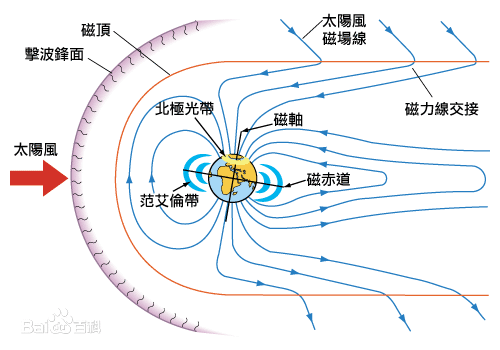
The magnetosphere
The geomagnetic field is not isolated: it is affected by disturbances from outside, and spacecraft have confirmed the existence of the solar wind. The solar wind is a hot, fast, low-density stream of particles ejected from the solar corona into interplanetary space, composed mainly of ionized hydrogen and ionized helium.
Because the solar wind is a plasma it carries a magnetic field, and that field acts on the geomagnetic field as if it would blow it away from the Earth. Even so, the geomagnetic field effectively prevents the solar wind from penetrating directly. Deflected by the field, the solar wind flows around it and continues onward, so that a comet-shaped region of the geomagnetic field, enveloped by the solar wind, is formed — the magnetosphere.
The magnetosphere begins 600–1000 km above the top of the atmosphere. Its outer boundary, the magnetopause, lies 50,000–70,000 km from the ground. Compressed by the solar wind, the field lines on the night side stretch far into space, forming a long tail — the magnetotail. Near the magnetic equator there is a special surface on which the field lines suddenly reverse direction; it is called the neutral sheet. The field strength at the neutral sheet is negligible, and the sheet is about 1000 km thick. It divides the magnetotail into two parts: field lines to the north point towards the Earth, those to the south away from it. It was found in 1967 that within about 10 Earth radii either side of the neutral sheet the region is filled with denser plasma; this is the plasma sheet. When solar activity is strong, the number of energetic particles in the plasma sheet increases and they precipitate rapidly along the field lines towards the polar regions — producing the aurora in all its forms. Because the solar wind approaches the edge of the geomagnetic field at high speed, a collisionless bow shock forms. The transition region between the shock front and the magnetopause is called the magnetosheath, and is 3–4 Earth radii thick.
Position of the magnetic poles
| 2001 | 2004 (est.) | 2005 (est.) | Location | |
|---|---|---|---|---|
| Magnetic north pole | 81.3° N, 110.8° W | 82.3° N, 113.4° W | 82.7° N, 114.4° W | Near the geographic south |
| Magnetic south pole | 64.6° S, 138.5° E | 63.5° S, 138.0° E | — | Near the geographic north |
Distribution
According to the rotating mass-field hypothesis, the Earth generates its magnetic field as it rotates. From the viewpoint of the relativity of motion, however, an observer standing on the Earth’s surface should not sense the geomagnetic field at all, because the observer is at rest relative to the surface and rotates with the Earth — so a person on the Earth cannot feel the magnetic effect produced by its rotation. What is usually called the geomagnetic field is only the field at the Earth’s surface, not the global (space) field of the Earth, which is produced by the rotation of the core.
The Earth’s interior is divided into crust, mantle and core. Experiments reported by American scientists found that the inner and outer parts of the Earth rotate at different rates: the core rotates faster than the crust. In other words, although a person on the surface cannot sense the Earth’s rotation, they can sense the mass-field effect produced by the rotation of the core — and that is what produces the surface field. The same work found that the rotation axis of the core is not collinear with that of the Earth, so the poles of the field produced by the core do not coincide with the geographic poles; this is the origin of magnetic declination.
How the field changes
Research has shown that the geomagnetic field changes: not only does its strength vary, but the poles move, and from time to time a reversal of polarity occurs. As early as the beginning of the twentieth century the French scientist Bernard Brunhes found evidence that the field had reversed 700,000 years ago; in 1928 the Japanese scientist Motonori Matuyama reached the same conclusion. After the Second World War, palaeomagnetic research developed rapidly and increasing evidence of reversals was obtained. When magma cools and solidifies into rock it is magnetized by the ambient field and retains a remanence whose direction matches the field at the time of formation. Some rocks were found to be magnetized in the same direction as the present field, others in exactly the opposite direction. From magnetic surveys of continental rocks and ocean-floor sediments, and from the analysis of magnetic anomaly stripes on the ocean floor, it was established that the Earth’s field has reversed 171 times in the past 76 million years. The most recent reversal occurred about 700,000 years ago, as Brunhes had indicated.
On the rotating mass-field hypothesis, a reversal is caused by a change in the angular velocity of the core. The crust and the core do not rotate in step; at present the core rotates faster. Four billion years ago the situation was different: the surface was molten, the Moon had only just been captured, and the Earth rotated as a single body from inside out, so there was no surface field. As angular momentum was transferred to the Moon, the Earth’s rotation slowed. At the same time the Earth gradually differentiated into crust, mantle and core. The change in the Earth’s angular momentum was first reflected in the crust, so that the crust came to rotate more slowly than the core. At that point a field could be sensed at the surface for the first time, the core rotating faster than the crust producing the geomagnetic field. By the left-hand rule, the N pole of that field lay near the geographic south and the S pole near the geographic north.
This lack of synchronism cannot persist indefinitely: the core must transfer angular momentum to the crust through the asthenosphere, so the core slows and the crust speeds up. When the two angular velocities finally become equal, the field disappears from the surface. The transfer does not stop there: by inertia the crust continues to speed up and the core to slow down, so the crust comes to rotate faster than the core. A mass-field effect from the core rotating opposite to the Earth’s rotation is then sensed at the surface, and by the left-hand rule the newly formed field has its N pole near the geographic north and its S pole near the geographic south. Over the long term the whole Earth is decelerating, but the relative velocity between crust and core varies periodically — which is why the field reverses from time to time.
Measurements indicate that a reversal is preceded by clear warning: the field strength falls to zero, and then over roughly ten thousand years recovers — but with the opposite polarity. Field strength is trending downward; over the past 4000 years the strength over North America has fallen by 50 %, which suggests that the velocity difference between core and crust is shrinking. It should be noted that, however the surface field changes direction, the direction of the Earth’s field in space remains unchanged, because what is measured in space is the rotating mass-field effect of the Earth as a whole, which does not change with the relative velocity of crust and core. By the left-hand rule, the N direction of the field measured in space always lies above the geographic south.
In electromagnetic induction, the field produced by a current-carrying conductor is proportional to the current — that is, to the number of free electrons moving in a directed way. Each electron has a constant spin angular momentum, so the field strength is in fact proportional to the sum of the spin angular momenta of all the electrons. By the same reasoning, the field produced by a macroscopic body should be proportional to the angular momentum of its rotating mass field: proportional to the mass and to the angular velocity, and inversely proportional to the radius of rotation of that mass field (the distance from the observation point to the body’s centre of mass).
In near-Earth space the field produced by the Earth is stronger than the field at the surface. Its defining characteristic is that the poles are constant: unlike the surface field, it does not undergo polarity reversals.